|
Check out Delmi's October newsletter!
| |
|
|
Message from the Head of Secretariat
In mid-June, the Government’s decision on Delmi’s new directives was finally announced. The supplementary directives adopted at that time replace our previous directives in their entirety and will remain in force until the Government takes a decision, no later than 2028, on the long-term organisation and remit of Delmi.
The supplementary directives for Delmi safeguard the committee’s continued independence, whilst at the same time setting out a clear ambition to strengthen cooperation with the Government Offices and also with various societal stakeholders. By working more closely together, we can become even better at both understanding and meeting the needs of our target groups and, hopefully, also gain further traction for the knowledge we produce and disseminate. This will require us to further develop our ability to produce easily accessible knowledge resources, whilst maintaining a solid foundation in research. At the Delmi Secretariat’s planning day recently, we devoted our time to reviewing the supplementary directives and discussing how they can be put into practice. A few words that stood out to me during our discussions were independence, relevance and innovation. Independence is one way of describing Delmi’s autonomy. To remain credible, it is vital that we are an independent body, free from political and other forms of control, whilst at the same time – naturally – being influenced by the wider world and thus also devoting our time to conducting research on matters that are important for societal development.
| | |
The importance of relevance is a recurring theme in our context. It may seem self-evident that an organisation such as Delmi should always be relevant. It is therefore particularly important that we think critically from multiple perspectives: Relevant to whom? How are we relevant? Can we become more relevant by developing our working methods and communication channels? Last but not least, we need to ensure that we remain innovative and forward-looking. It goes without saying that we should study a selection of current migration issues, but it is at least as valuable for us to stay one step ahead and explore what ‘lies just round the corner’ and may become significant in the field of migration in the future. As the saying goes, without foresight, there is no insight.
The new supplementary directives require us to approach our remit in a partly new way, whilst also continuing with what we already do well today. Generating and sharing knowledge with others also means continuous learning for ourselves, which becomes particularly clear in light of our expanded remit. We hope that those of you who follow us will notice this in a positive light. As always, please feel free to get in touch with us at the Delmi secretariat if you have any questions, comments or ideas regarding our work!
| Agneta Carlberger Kundoori,
Head of Secretariat
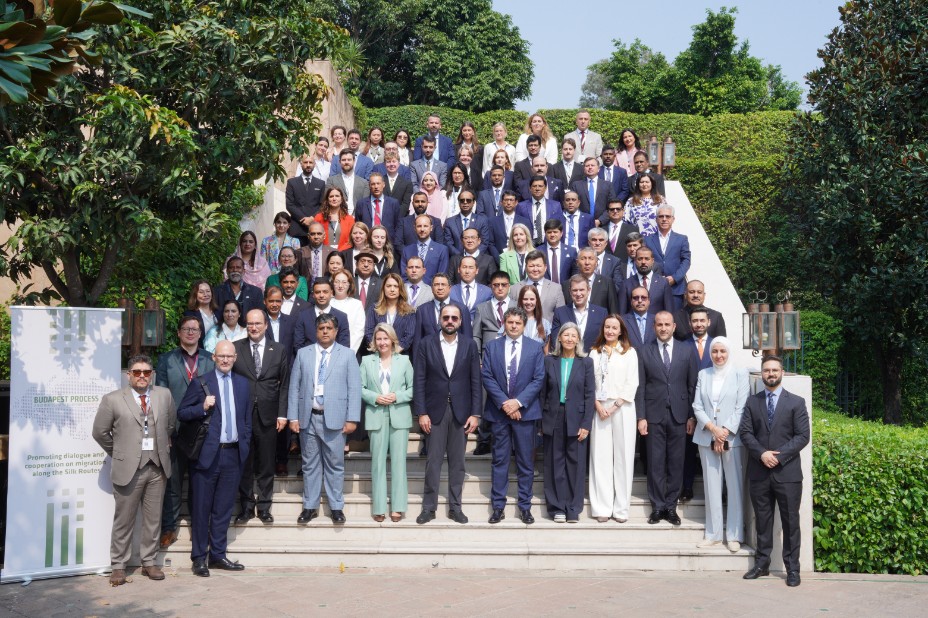
| | | | | Picture: ICMPD Silk Routes & Budapest Process. Delmi in Islamabad: Latest news on the Legal Migration project
On September 1st, 2025, a new AMIF-funded project was launched at Delmi. The project, From Information to Migration: Information Sharing in Third Countries and Its Significance for Legal Migration to Sweden, aims to enhance knowledge about the opportunities and challenges related to information sharing about legal migration in Iraq, Uzbekistan, and Pakistan.
In September, parts of the author group traveled to Pakistan to participate in the Budapest Process’s thematic meeting in Islamabad. More than 100 participants from 23 countries, 10 partner organisations and 13 private‑sector representatives gathered in Islamabad to strengthen skills‑based labour mobility partnerships and advance cooperation on legal pathways for migration.
During the meeting, they presented findings from Delmi’s upcoming report Organization of Regular Migration Routes and Information Sharing in Third Countries—Lessons and Implications for Sweden, which is part of the AMIF-funded project From Information to Migration: Information Sharing in Third Countries and Its Significance for Legal Migration to Sweden. In the report, we examine how regular migration routes for work and study are organized and communicated in Iraq, Uzbekistan, and Pakistan, as well as the implications this may have for Sweden’s ability to develop a more coordinated approach to regular migration.
| "The discussions during the meeting gave us the opportunity to place the findings of our study in a broader context. Many of the experiences and perspectives shared by the participants closely aligned with our observations on how regular migration pathways are organised and communicated." Iris Luthman, research Coordinator and co-author of the report. | | | |
The meeting provided a valuable opportunity to present the preliminary research findings and discuss them with representatives from various countries and organizations that work to prepare and support people who wish to migrate for work or study purposes, as well as with stakeholders and countries involved in recruiting workers from third countries.
The final report is scheduled to be presented in December 2026 in Stockholm. There may be additional launch events. Keep an eye on the tab Legal Migration for more information!
|
Recent publications available in English
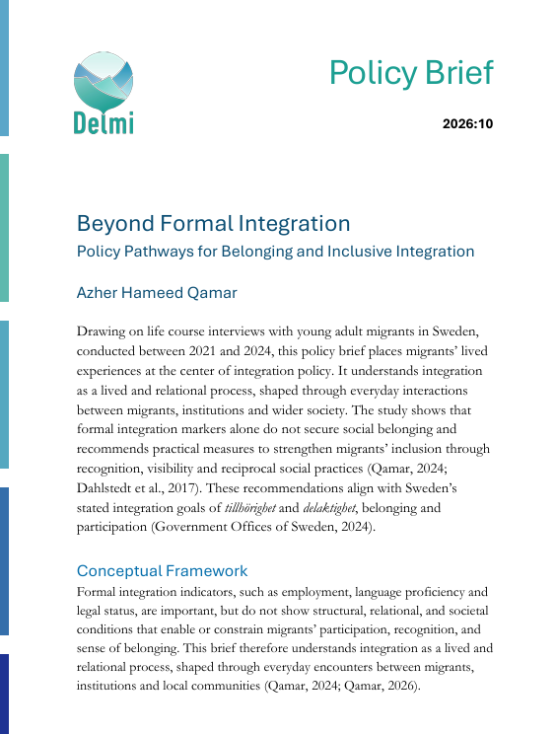
| Policy brief 2026:10 Beyond Formal Integration. Policy Pathways for Belonging and Inclusive Integration
The EU’s new Migration and Asylum Pact aim to create a more effective and sustainable migration system, with a clearer division of responsibilities between Member States and common rules for asylum procedures and border controls.
This policy brief examines the extent to which a child rights perspective characterises the Pact. The analysis is based on the Convention on the Rights of the Child and the EU’s rights framework, where principles such as the best interests of the child, non-discrimination and the right of the child to be heard are central. The policy brief also highlights the measures proposed to implement the Pact in Sweden. The policy brief’s author is Rebecca Thorburn Stern, a professor of international law at Uppsala university.
| | | | Policy brief 2026:9 Voluntary Returns to Syria: Mapping Return Aspirations and Motivations of Syrians Residing in Sweden and the EU
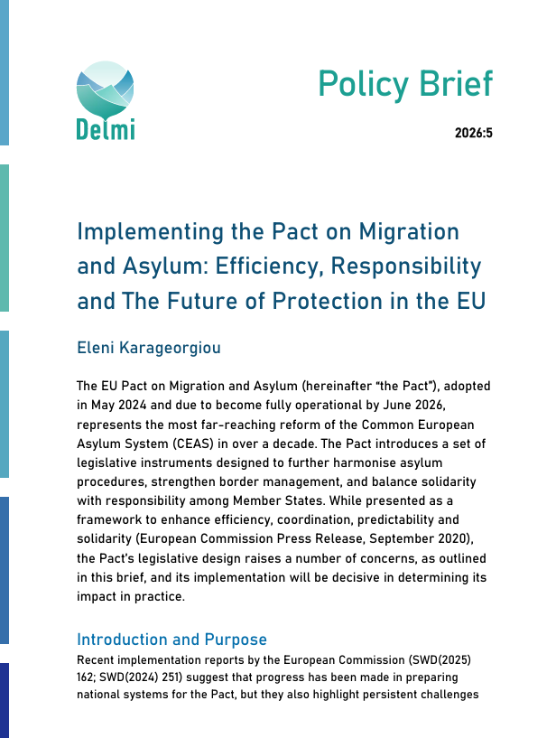
The EU Migration and Asylum Pact, adopted in May 2024 and due to be fully implemented in June 2026, represents the most comprehensive reform of the Common European Asylum System in over a decade. This policy brief analyses how the implementation of the Pact may affect access to protection within the EU. Despite progress in Member States’ preparations, recent reports indicate that significant challenges remain, including in terms of reception capacity, infrastructure and coordination. The policy brief argues that implementation risks reinforcing a border-centred migration system, where a focus on efficiency and control may come at the expense of rights and legal certainty. Particular attention is drawn to the expansion of border procedures, increased possibilities for detention, and the increased use of external partnerships and so-called safe third countries.
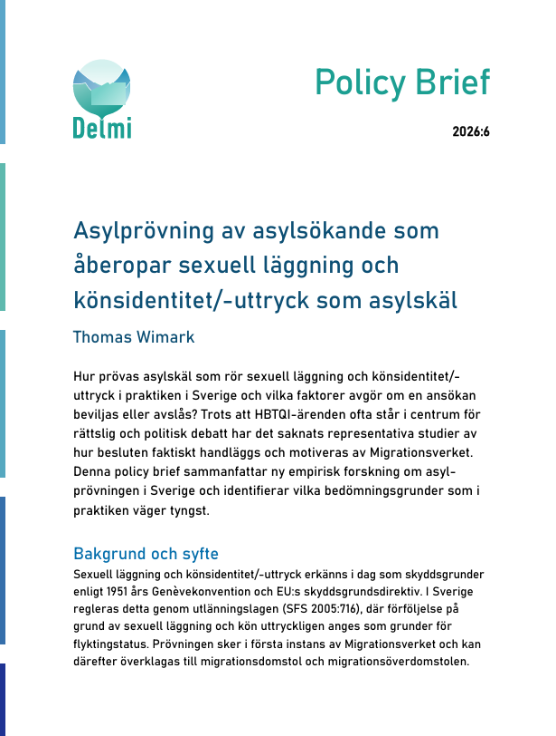
| | | | Policy brief 2026:6 Assessment of asylum claims by applicants who invoke sexual orientation and gender identity/expression as grounds for asylum
This policy brief summarizes three studies by Thomas Wimark (2025) on the asylum determination of individuals who invoke sexual orientation and gender identity as grounds for asylum. The studies are based on 3,588 randomly selected asylum decisions from the Swedish Migration Agency (2020) and combine descriptive statistics with logistic regression models to examine how the likelihood of being granted asylum varies across different grounds for asylum and which factors influence recognition rates. The findings show, among other things, that the current model for assessing HBTQI cases at the Swedish Migration Agency places considerable weight on narrative detail and emotional authenticity, which raises rule of law concerns and may create incentives for applicants to adapt to prevailing assessment criteria.
| | | | Picture: Niamat Ullah via Unsplash. | Migrants and Military Service
Which groups undergo conscription screening and are accepted for military service in Sweden?
The defense sector is expanding, and the need to recruit personnel is expected to increase in the coming years. Conscription forms the basis of the Swedish Armed Forces’ personnel supply, which makes the question of who is recruited into total defense particularly relevant. The upcoming policy brief analyzes the extent to which individuals from different social and demographic backgrounds undergo conscription screening and are accepted into military service, with a particular focus on individuals with a foreign background.
The studies are based on data from the Swedish Defence Conscription and Assessment Agency and Statistics Sweden and cover 476,623 Swedish citizens subject to total defense service who were born between 2000 and 2004. The aim is to contribute knowledge about recruitment to military service and to highlight the factors that may influence the representativeness of Sweden’s total defense forces. The policy brief is written by Andreas Savelli, Research Coordinator
at Delmi.
Read more here: Migrants and Military Service - Delmi. | Picture: A.C via Unsplash. | The RUT tax deduction as a pathway into the labour market
Does the RUT tax deduction contribute to greater labour market integration?
The RUT tax deduction has been a central feature of Swedish labour market and integration policy since its introduction. This upcoming policy brief examines the role of the RUT tax deduction in the labour market integration and mobility of foreign-born individuals, including whether employment in the RUT sector serves as a stepping stone to more qualified and better-paid jobs. The project also explores the significance of the RUT tax deduction for entrepreneurship and opportunities to move into managerial positions. The analysis is based on the research project Does the RUT tax deduction contribute to increased integration and labour market mobility among immigrants?, led by Karin Halldén at Mälardalen University and Stockholm University together with Anders Stenberg at Stockholm University. The two researchers are also responsible for writing the policy brief. The project is funded by the Swedish Research Council within the framework of the national research programme on migration and integration. Read more here:
The RUT tax deduction as a pathway into the labour market - Delmi. | Picture: This image was generated by AI. | Language at and for work
How can language training during working hours strengthen both communicative skills and labour market integration for foreign‑born individuals?
The upcoming report examines the effects of workplace-based language development initiatives for foreign-born employees and
the extent to which language training during working hours can enhance both actual and perceived communicative competence in Swedish. The study is grounded in the observation that traditional Swedish for Immigrants (SFI) programmes do not always meet employers’ needs, and that there is a lack of evidence-based knowledge on how workplace language learning functions in practice.
The project is carried out in cooperation with eight municipalities in the Kronoberg region and includes employees primarily in the industrial sector and in health and social care. The findings are expected to contribute new knowledge on how workplace-based language initiatives can support labour-market integration and skills supply.
The report is written by Fanny Forsberg Lundell, Professor of French at Stockholm University and part-time researcher at Ratio, and Klara Arvidsson, researcher at the Institute for Language and Folklore (Isof).
Read more here: Language at and for Work - Delmi. | Picture:
Dylan Gillis via Unsplash. | Labour market policy interventions in socioeconomically disadvantaged areas
How can labour market policy interventions contribute to labour market integration for residents of socioeconomically disadvantaged areas?
The literature review synthesises and analyses research on labour market policy interventions that can contribute to labour market integration for people living in socioeconomically disadvantaged areas. The review takes as its starting point the close association between residential segregation, the concentration of socioeconomic disadvantage and unequal life chances in the labour market. It examines interventions for groups overrepresented in socioeconomically disadvantaged areas, as well as the effects and implementation of area-based initiatives. A particular focus is on what the research can tell us about the added value of organising interventions geographically and prioritising participants based on their area of residence. The publication is written by Anders Forslund, professor emeritus at The Institute for Evaluation of Labour Market and Education Policy (IFAU).
Read more here:
Labour market policy interventions in socioeconomically disadvantaged areas - Delmi. | Picture:
Adolfo Felix via Unsplash. | From Information to Migration: Information Sharing in Third Countries and its Significance for Legal Migration to Sweden
A project funded by the Asylum, Migration and Integration Fund (AMIF).
The project examines how regular migration pathways for study and work are organised and understood, with a particular focus on how information is communicated to potential migrants. It also aims to identify key lessons and analyse their implications for Sweden’s approach to regular migration. The upcoming report focuses on Iraq, Uzbekistan, and Pakistan, highlighting both internal and external coordination challenges that affect the conditions for successful migration partnerships between countries of origin and destination. The findings contribute to a better understanding of how Sweden can strengthen its labour supply through international recruitment and migration.
The project is financed by the Asylum, Migration and Integration Fund (AMIF), an initiative supporting EU member states in their work of implementing common asylum and migration policies.
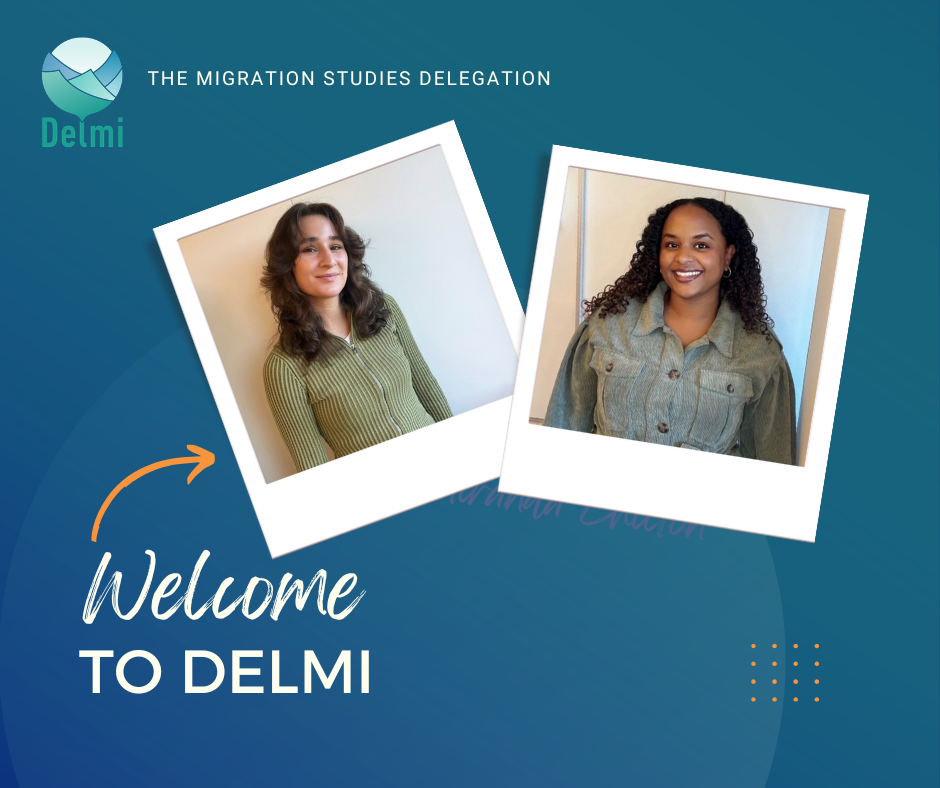
The report is written by Pinar Aslan Akay, Iris Luthman and Jenny Bergsten, all of whom work as Research Coordinators at Delmi. Read more here: Legal Migration - Delmi. | New colleagues at Delmi! Welcome Alice and Ruth, our new autumn interns at Delmi! We’re excited to have you on the team and to see all the great things you will contribute with.
- Why did you apply for an internship at Delmi?
Alice: I applied for an internship at Delmi because I’ve been interested in migration research throughout my studies, and I felt that Delmi’s focus on how research can contribute to well-founded policy proposals was very much in line with how I want to work in the future. Ruth: Above all, because Delmi does such important work. I studied human rights and am genuinely passionate about how high-quality research can be put into practice to help create both better policies and a more informed public debate. It simply feels like the perfect place where research, policy, and society truly come together. - What are you looking forward to learning during your internship?
Alice: I’m looking forward to getting involved in the ongoing research and projects Delmi is working on. It will also be particularly interesting to gain a better understanding of the research gaps that exist in migration research and what knowledge is needed going forward to increase understanding of migration issues and contribute to policy-relevant proposals. Ruth: I’m really looking forward to seeing the “craft” behind the work, how you go from rigorous research to concrete recommendations for policymakers. I also want to sharpen my skills in policy analysis and learn how to communicate complex issues effectively. It will be exciting as well to see how migrants’ own perspectives and rights are incorporated into the work. - Which area of migration are you particularly interested in?
Alice: I find it difficult to choose a specific area, but during my studies I’ve worked a lot with quantitative methods and interpreting statistical models. That’s why I’m interested, among other things, in how migration and all its various aspects can be interpreted and understood from a quantitative perspective. So, becoming better at illustrating and explaining statistics to the general public regarding various aspects of migration is something I’m interested in, as well as how to correctly interpret and use statistics to develop well-established policy proposals. Ruth: I almost always find myself drawn to the intersection of migration and human rights, particularly issues related to social inclusion, asylum law, and children fleeing conflict. What I find especially interesting is how policies affect people’s everyday lives and their opportunities to become part of society. I’m also fascinated by how states try to balance managing migration with upholding their international commitments. Interested in an internship at Delmi in spring 2027? Keep an eye on our website and LinkedIn page, where we will soon publish information about the next internship. | Thank you for following our work! | |
Delegationen för migrationsstudier |
|
|
|