Message from the Head of Secretariat
As we mentioned in our previous newsletter, the government has stated in
its budget proposal for next year that Delmi's organisational structure and
future governance will be reviewed, in order to meet the need for data. In
practice, this means an extension of Delmi's mandate in its current form until
2026. At the end of November, the government made the formal decision on such
an extension (only available in Swedish). We are, of course, delighted to be able to continue our current mission
for at least another year, while we also intend to be active in the longer-term
management of our role as a bridge between research, practice and politics.
As the year draws to a close, Delmi is holding a longer committee meeting
to, among other things, set the strategic direction for the work in the coming
year. At the full-day meeting the other week, Delmi's programme and strategy
for 2026 was discussed, along with the action plan that sets the framework for
the priorities to be set during the year. Among the things we will be focusing
on in 2026 are continued monitoring of migration and integration issues within
the Tidö Agreement, highlighting various aspects of the EU's migration and
asylum pact, raising awareness of the link between migration, aid and
development, and studying issues relating to repatriation / voluntary return
migration and legal channels for migration respectively. One of the major tasks
we will look deeper into in 2026 will also be our contribution
to knowledge building in relation to the parliamentary, regional and municipal
elections in September, given that the area of migration and integration is
often given space in the debate but is not always highlighted from a factual
and evidence-based perspective. This is where Delmi can make a difference.
Delmi's impact, i.e. how we reach our target
groups, is a constantly relevant issue and challenge. This year, we have contracted
the Strategy Council to examine our impact in a more qualitative way.
| | |
The results are positive, although there are, of course, areas for
development. Among other things, the survey shows that we contribute to work
development, that what we publish and communicate forms the basis for other
actors' positions and knowledge-raising efforts, that we contribute to a deeper
and more nuanced understanding of the field of migration and integration and
that we are a unique function as a knowledge hub and arena for dialogue. This
is a strong confirmation that our work is important! Looking ahead, we will
work more on developing our channels to our target groups and becoming even
better at meeting the specific knowledge needs of our recipients. If you have
any thoughts on how we can develop in this regard, please feel free to contact
us.
The last few weeks of 2025 will be very busy at the Delmi secretariat.
During the Swedish Forum for Human Rights (“MR-dagarna”) in Stockholm on 9-10
December, we will be organising an English speaking seminar, in addition to several other activities
related to ongoing Delmi studies. It is a great honour for me to be part of
such a competent and committed group as Delmi's secretariat staff and to be
able to collaborate with and meet so many talented people in our multifaceted
network. Thank you all for a very educational and energetic 2025!
Merry Christmas and Happy New Year!
| Agneta Carlberger Kundoori,
Head of Secretariat
| | | | | Picture:
Adolfo Felix
via Unsplash. Interview about a new project on Legal Migration On September 1st, 2025, a new AMIF-funded project was launched at Delmi. The project, From Information to Migration: Information Sharing in Third Countries and Its Significance for Legal Migration to Sweden, aims to enhance knowledge about the opportunities and challenges related to information sharing about legal migration in Iraq, Uzbekistan, and Pakistan. Pinar Aslan Akay, author and responsible for the scientific process for Delmi’s up-coming report, is currently in Pakistan.
Hi Pinar! Can you tell us about your trip to Pakistan and what you are doing there? We are
travelling to Islamabad to conduct the first of three field studies within the
project. During our stay, we will collect empirical material through interviews
with governmental actors, international organisations and relevant NGO's.
This
includes conversations with government officials working on migration
governance and legal pathways, organisations that meet and inform potential
migrants about regular migration pathways, and civil society actors who support
individuals considering migration in various ways. This work is crucial because
it helps creating realistic expectations and ensures that potential migrants
receive accurate and relevant information about destination countries.
At the same
time, there are both opportunities and challenges shaping how the provision of information
is formed and executed. The field study therefore provides an important
opportunity to examine which aspects function well and which may need to be
strengthened for information efforts on legal pathways to become more effective
and meaningful. Which parts of the trip do you think will be the most interesting or surprising? What will
likely be most interesting is gaining a concrete understanding of how
information activities actually operate in practice, and how different actors
navigate complex regulations, organisational frameworks and the needs of
individuals. It will also be valuable to see how advisers and other
professionals interpret their mandate, and how their room for manoeuvre is
shaped by political and institutional conditions. Overall, I expect the trip to
generate many important and insightful contributions to the study.
| "The field study therefore provides an important opportunity to examine which aspects function well and which may need to be strengthened for information efforts on legal pathways to become more effective and meaningful." Pinar Aslan Akay, author and scientifically responsible. | | | | What are the next steps in the project?
The next
step is to conduct field studies in Baghdad and Erbil at the end of January,
followed by fieldwork in Tashkent in early March. Once all material has been collected,
we will begin the analysis, systematically reviewing interviews and other data
to identify recurring themes and patterns, as well as important differences
linked to political, institutional and social or cultural contexts in the
respective countries. The results will be published next autumn, and we look
forward to sharing the study’s findings with others who are interested in these
issues.
Want to know more? Visit Delmi's newly launched section on the website, Legal Migration, for more information and regular updates.
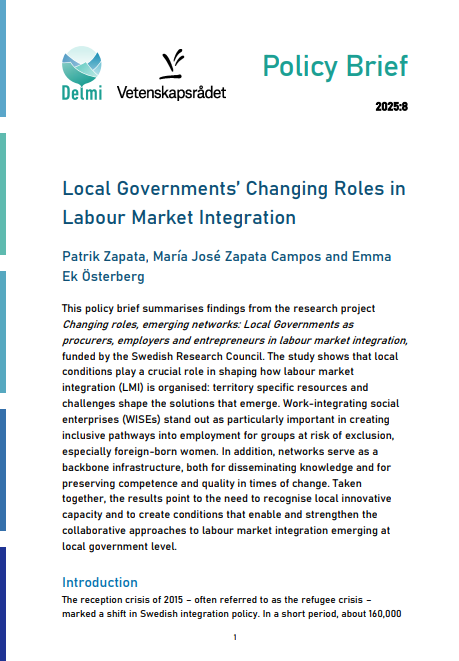
| Policy brief 2025:8 The Changing Roles of Local Governments in Labour Market Integration
This Delmi policy brief shows how municipalities across
Sweden are developing their own models and forms of collaboration for the
labour market integration of newly arrived migrants – often in the absence of
clear national guidelines.
The brief was
launched at a seminar in the series Conversations on Migration and
Integration – Researchers Meet Practitioners, organised by Delmi in
collaboration with the Swedish Research Council. There, researchers and
practitioners discussed how long-term sustainable systems can be built at the
intersection of local initiatives, national policy and cross-sectoral
cooperation.
The panel discussion
also highlighted an important observation: today’s very low numbers of newly
arrived migrants are creating a kind of reverse reception crisis. For
municipalities, this poses significant challenges in maintaining quality and
continuity in integration efforts when activities become increasingly difficult
to sustain.
| | The policy brief is written by Patrik Zapata, is Professor of Public Administration, María José Zapata Campos, Professor of Business Administration, and Emma Ek Österberg, Associate Professor of Public Administration. All three are based at the University of Gothenburg.
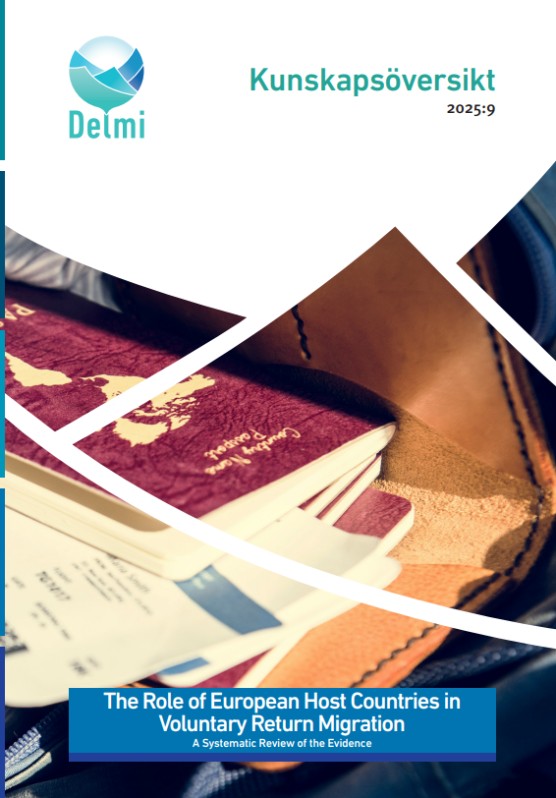
Download the policy brief here:The Changing Roles of Municipalities in Labour Market Integration - Delmi. | | | | Reseach overview 2025:9 The Role of European Countries in Voluntary Return Migration: A Systematic Review of the Evidence
The
research overview presents the findings of a systematic review examining
literature on the role of European national governments in influencing
voluntary return migration of immigrants residing in their country. The overview found
very limited evidence that European countries’ direct attempts to increase
return migration – such as travel cost coverage, reintegration support, and
financial incentives – lead to significant increases in voluntary return
migration. Financial support is necessary to remove barriers to return but is
insufficient to motivate return among migrants who are well-integrated in or
who maintain strong ties to the European host country.
However, more
indirect measures seem to have an effect. The preservation of legal status,
access to mobility rights (such as dual citizenship or re-entry possibilities)
and transnational connections emerged in this systematic review of the
literature as enablers of voluntary return. Migrants were more willing to
consider return when they were not being permanently cut off from the European
country where they resided as immigrants.
| | | | Report 2025:10 Health and Migration in a Global Context
The report asks how
healthy those who intend to migrate in the near future are and examines the
link between health and migration, with a particular focus on, and based on the
hypothesis that, healthier individuals are more likely to want to migrate. The
study is based on data collected from a large number of countries of origin and
covers individuals' attitudes to both internal and international migration.
The results of the
study confirm that individuals who perceive themselves to be in better health
are, on average, slightly more likely to want to migrate. However, this
positive correlation disappears when age is taken into account. Since younger
individuals tend to be both healthier and more inclined to migrate, the
observed correlation between health and migration preferences appears to be
driven by age differences rather than a direct effect of health status. When
comparing individuals of the same age, those who are in better health are
slightly less inclined to want to migrate.
The report's
conclusions reinforce the view that migration should not only be seen as a
challenge for the receiving countries, but can also be an important addition to
society's resources. | | The report is written by
Mikael
Elinder, Professor, Department of Economics, Uppsala University, and Oscar
Erixson, Associate Professor, Institute for Housing and Urban Research (IBF),
Uppsala University.
Download the report here (only available in Swedish):
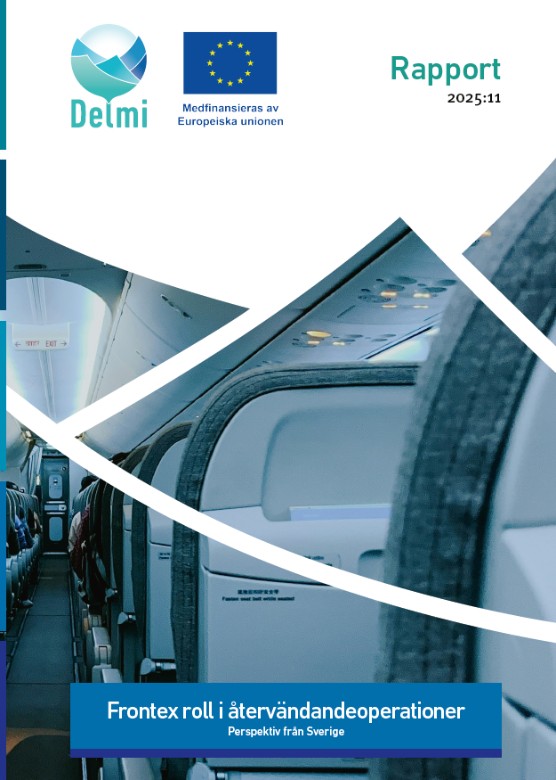
Health and Migration in a Global Context - Delmi. | | | | Report 2025:11 Frontex’s Role in Return Operations – Perspectives from Sweden
The final and concluding sub-report in Delmi’s
AMIF-funded project Return as International Migration Policy focuses on
the European level. The most prominent actor is the EU agency Frontex, which
serves as an operational arm and support for many member states.
Sweden is one of the member states that makes the greatest use of Frontex’s return support. But how do Swedish authorities view this cooperation—does it contribute to a more efficient, humane, and sustainable return process? The results show that authorities largely appreciate Frontex and have a well-functioning collaboration, but they primarily view this cooperation from a national or agency-specific perspective.
| | The report is written by Daniel Silberstein, Ph.D. in
International Relations, Suzanne Planchard, M.A. in International Relations and Henrik Malm Lindberg, Associate Professor in Economic History. All authors
work at the Delmi Secretariat.
Download the report here (only available in Swedish):
Frontex’s Role in Return Operations – Perspectives from Sweden - Delmi. | | | | Picture: Poster for Human Rights-days. Up-coming seminar:
Integrating Migration in Development Aid – Lessons from Europe
Almost two years have passed since the Swedish government introduced its reform agenda for development cooperation, followed by a strategy for global engagement on migration, return, and readmission. As a result, questions about how migration policy objectives are integrated into development aid have gained renewed relevance—both as matters of governance and of values. Which goals are prioritized? How is the content, direction, and legitimacy of aid affected? The seminar is arranged together with The Expert Group for Aid Studies. Participants: - Henrik Malm Lindberg, Deputy Head of Secretariat at Delmi
- Johan Schaar, Associate Senior Fellow at SIPRI
- Jesper Bjarnesen, Senior researcher at The Nordic Africa Institute
- Jessica Schultz, Senior Reseacher, Christian Michelsen Institut
- Moderator: Mats Hårsmar, Deputy Head of Secretariat at The Expert Group for Aid Studies
Date: Wednesday December 10 Time: 12.00-13.00 Place: Kistamässan in Stockholm, room M6 Read more at Delmis website and buy tickets here.
|
Watch Delmi’s seminars online
Did you know that Delmi usually records its seminars? This means you can choose to attend in person in Stockholm, where our office is based, or watch the livestream online. If you miss the livestreaming, you will have the opportunity to watch the recording afterwards on Delmi’s website, whenever it suits you the best. Watch all our recorded seminars on Delmi's seminar page on the website or on our Vimeo-account.
| Thank you for following our work! We at Delmi wish you a Merry Christmas and a Happy New Year. | |